

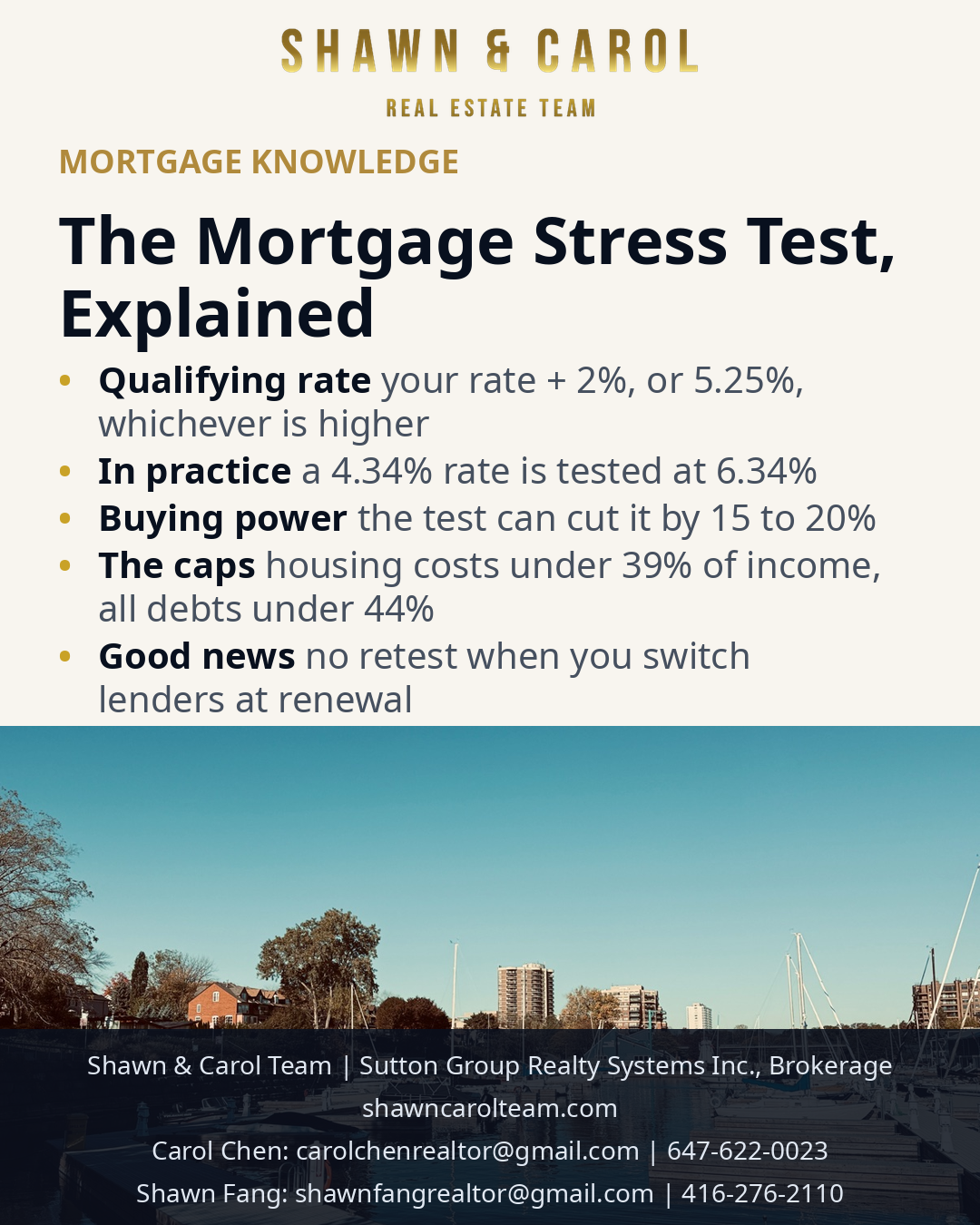
You found the home and ran the numbers. Then the bank told you that you qualify for less than you expected. The reason is probably the mortgage stress test.
It does not decide whether you are a good borrower, and it does not change the rate you will actually pay. It is a safety check, and once you understand it, you can plan around it instead of being surprised by it.
What Is the Stress Test?
The stress test is a rule from Canada’s banking regulator, OSFI, set out in its B-20 guideline. When you apply for a mortgage, your lender must check whether you could still afford the payments if interest rates were higher than they are today. That check uses a test rate called the qualifying rate. Your lender calculates your mortgage payment at the qualifying rate and checks it against your income and your other debts. If the numbers work at the higher rate, you pass. If they do not, the amount you can borrow comes down.
Who Does the Test Apply To?
The stress test applies to mortgages from federally regulated lenders, which includes Canada’s banks, whether your mortgage is insured or uninsured. Provincially regulated credit unions and private lenders follow their own rules, so the same buyer can get different answers from different lenders. It applies when you buy, refinance, or renew with a new lender, with one exception at renewal below. Your monthly payment is always based on your real contract rate; only the test uses the higher rate.
How the Qualifying Rate Works
The qualifying rate is the higher of two numbers: your contract rate plus two percentage points, or a floor of 5.25%. The floor has not changed since 2021, and it only binds when your contract rate is below 3.25%.
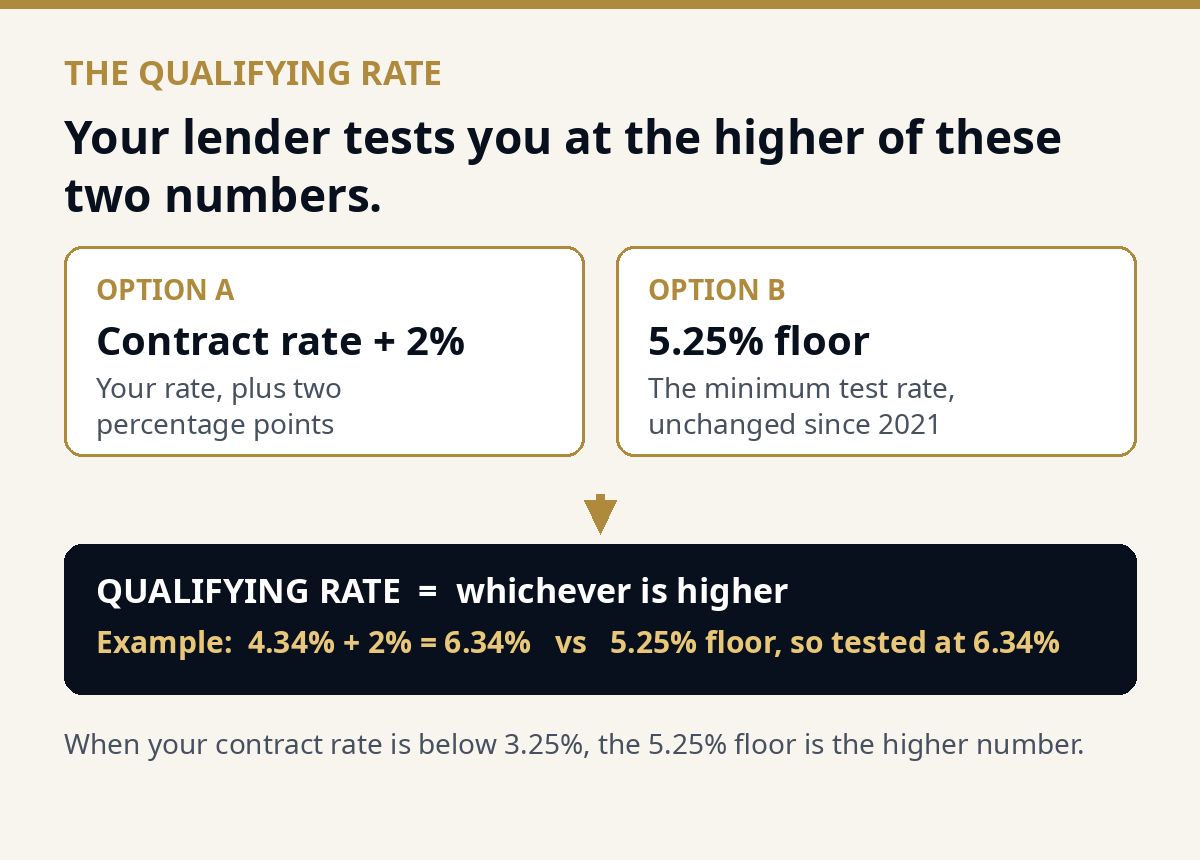
Say your contract rate is 4.34%. Add two points and you get 6.34%, which beats the 5.25% floor, so the bank tests you at 6.34%. At lower rates the floor takes over: a 3.00% contract rate plus two points is 5.00%, below the floor, so you are tested at 5.25%. A 5.00% contract rate is tested at 7.00%. The bank always uses the higher of the two numbers.
A Worked Example: What It Does to Your Buying Power
Take a household earning about $100,000 a year, with a contract rate of 4.34%. Tested at the contract rate alone, that household qualifies for a mortgage of about $499,000. Tested at the qualifying rate of 6.34%, the same household qualifies for about $421,000. That is a difference of about $78,000, and it is why the stress test typically cuts buying power by 15 to 20%.
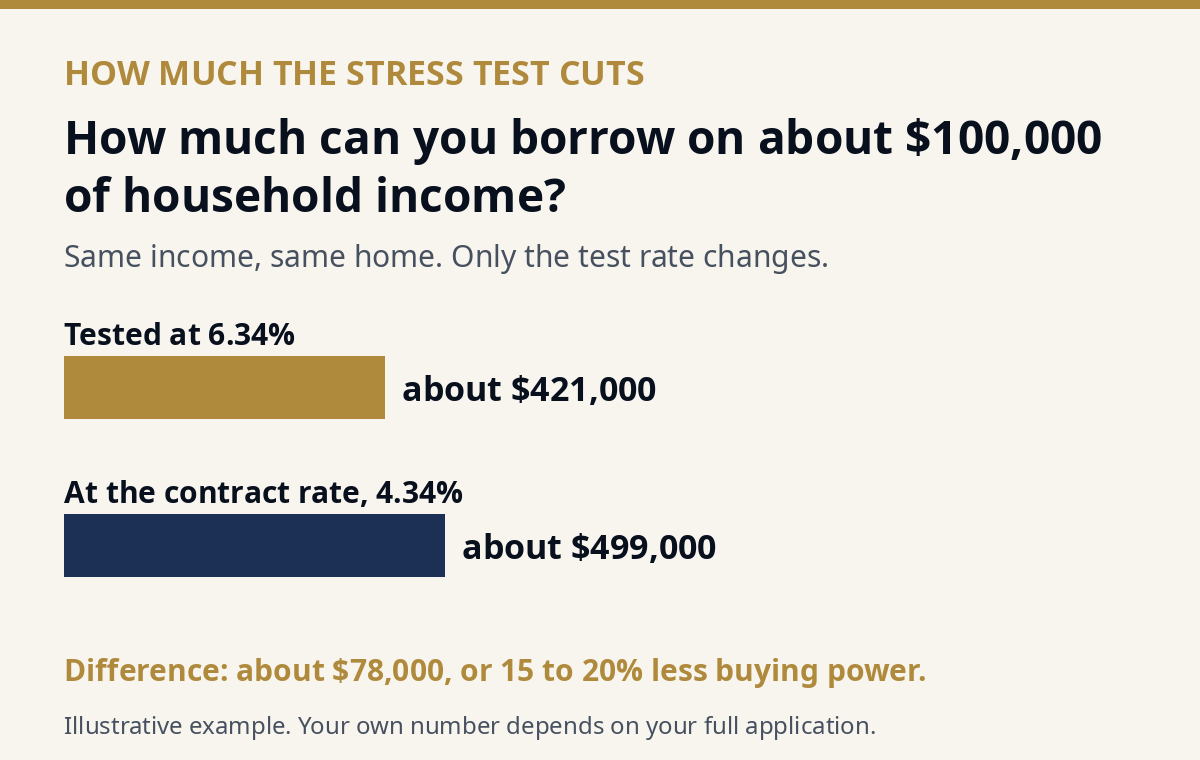
Nothing about the household changed. Same income, same home, same credit. The higher test rate means a higher test payment, and a smaller mortgage fits inside the lender’s limits. These are illustrative figures, but the pattern holds for almost every buyer: the stress test is usually the biggest reason the approved amount is lower than the amount you worked out at the advertised rate.
The Two Caps Behind the Number: GDS and TDS
Behind the qualifying rate sit two ratios that cap how much of your income can go to debt. Both are measured against your gross household income, before tax.
GDS, or Gross Debt Service, is capped at 39%. It covers your housing costs only: your mortgage payment, property tax, heating, and half of your condo fees.
TDS, or Total Debt Service, is capped at 44%. It covers everything in GDS plus all of your other debts: car loans, credit card payments, lines of credit, and student loans.
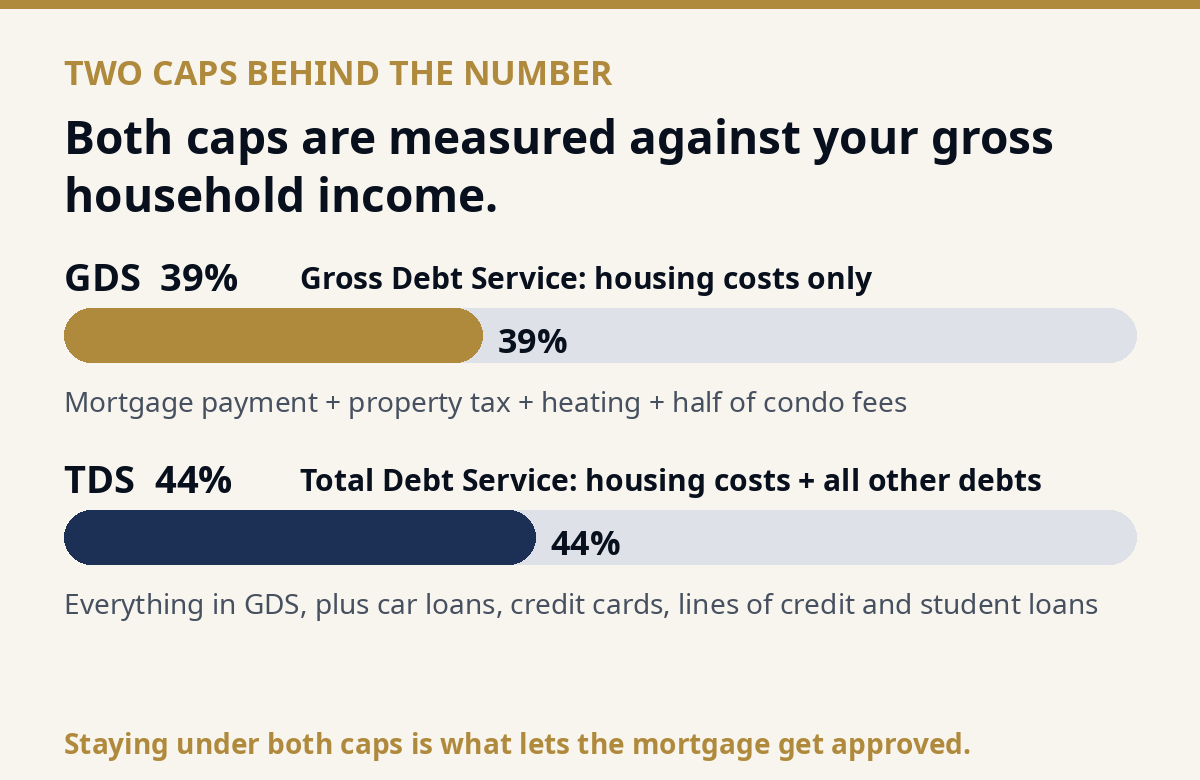
You have to pass both caps. A buyer with no other debts may find GDS is the binding limit, while a buyer with a car loan and credit card balances may find TDS holds the number down. Either way, the caps are why paying down a debt before you apply can matter so much.
Three Ways to Improve Your Number
Pay down other debts first. This is usually the fastest lever. Because TDS counts every debt payment, clearing a car loan or paying down credit card balances frees up room under the 44% cap, often moving your qualifying amount more than a small pay raise would.
Look at a longer amortization if you are a first time buyer. Since December 15, 2024, first time buyers can use a 30 year insured amortization. Spreading the same mortgage over more years lowers the monthly payment used in the test, which can lift the qualifying amount by about 5 to 6%. A longer amortization means more interest overall, so discuss it with your mortgage professional.
Shop the rate itself. A lower contract rate lowers the qualifying rate by the same amount. A rate of 4.34% is tested at 6.34%, while a rate of 4.09% is tested at 6.09%.
Good News at Renewal
Since November 2024, if you switch lenders at renewal and keep the same mortgage balance and amortization, you do not have to pass the stress test again. Before that change, homeowners who wanted to move lenders had to requalify, and some could not, even though they had never missed a payment. Now you can shop around at renewal without the test standing in the way, as long as you are not borrowing more or stretching the amortization.
Your Checklist Before You Apply
- Find your number early. Ask a mortgage professional to run the stress test on your income and debts before you start shopping, so you know your real budget.
- List every monthly debt. Car loans, credit cards, lines of credit, student loans. The bank will find them anyway.
- Pay down the smallest debts first if you can. Clearing one monthly payment helps the ratios more than trimming a large balance.
- Do not take on new debt while you shop. A new car loan in the middle of a home search can shrink your qualifying amount at the worst moment.
The Bottom Line
The stress test is the reason the number at the bank is often lower than the number in your head. The bank tests you at the higher of your contract rate plus two points or 5.25%, and on about $100,000 of income, a 4.34% rate tested at 6.34% means qualifying for about $421,000 instead of about $499,000. The GDS and TDS caps of 39% and 44% sit behind that number, and paying down other debts is usually the fastest way to improve it.
None of that makes the test your enemy. It is a guardrail, and buyers who understand it can plan around it: know your number before you shop, clean up the debts that count against you, and use the first time buyer amortization and the renewal exemption where they apply. It also does not mean you should borrow the maximum you qualify for. Passing the test means the lender is comfortable, not that the payment is comfortable for you.
If you would like to know what your number looks like, send us a message. We will walk you through it before you start shopping, so there are no surprises at the bank.
Shawn and Carol Team | Sutton Group Realty Systems Inc., Brokerage
shawncarolteam.com
Carol Chen: carolchenrealtor@gmail.com | 647-622-0023
Shawn Fang: shawnfangrealtor@gmail.com | 416-276-2110
This article is general information, not mortgage advice. Figures are illustrative examples based on the qualifying rate rule and the GDS and TDS caps; your own qualifying amount depends on your full application. Rates and rules can change. Speak with a licensed mortgage professional about your situation.